AI for Beginners In 2026: How To Start Learning Artificial Intelligence Today
Artificial Intelligence (AI) is no longer a distant or complicated technology limited to tech giants or PhDs in computer science. Today, it is woven into the very fabric of our daily lives—often without us even realizing it. From unlocking your phone using face recognition to receiving personalized recommendations on YouTube, Spotify, or Netflix, AI is silently working behind the scenes to make our experiences smoother, smarter, and faster.
If you’ve been thinking about learning AI but don’t know where to start, you’re in the right place. This beginner guide to learn AI in 2026 will walk you through everything you need to know, from understanding why it matters to actually getting your hands dirty with real projects.
As AI continues to grow, developers are no longer working alone. Modern AI-powered coding assistants, debugging tools, and automation platforms are helping programmers write better code in less time. If you want to explore which tools are actually worth using, check out our detailed guide on best AI tools for developers, where we break down the most powerful AI tools shaping modern software development.
Why Learning AI Matters in 2026
AI isn’t just another tech trend that’ll fade away. It’s becoming as fundamental as knowing how to use a computer or browse the internet. Companies across every industry are looking for people who understand AI, even at a basic level. But it’s not just about job opportunities.
Learning AI helps you understand the technology that’s already making decisions in your life. From the shows Netflix recommends to the routes Google Maps suggests, AI is everywhere. Understanding how it works gives you more control and makes you a smarter consumer of technology.
Plus, AI skills are surprisingly versatile. Whether you’re in marketing, healthcare, finance, education, or even creative fields like writing and design, knowing AI can make you better at what you do. It’s like learning a new language that opens doors you didn’t even know existed.
How AI Is Changing Our Daily Lives
Think about your typical day. You might ask Google Assistant or Siri about the weather, get navigation help from Google Maps, or chat with a customer support bot on a shopping website. These are all powered by different types of artificial intelligence:
- Voice Assistants (Alexa, Siri, Google Assistant) use natural language processing (NLP) to understand and respond to your questions.
- Recommendation Engines on YouTube, Amazon, and Netflix use AI algorithms to suggest content or products tailored to your preferences.
- Social Media Feeds on platforms like Instagram and Facebook are organized by AI to show you posts you’re most likely to engage with.
- Spam Filters in Gmail or auto-correct features in smartphones are also examples of machine learning in action.
These experiences may feel simple on the surface, but they are all possible because of complex AI models working in the background.
How AI Is Changing Our Daily Lives
Think about your morning routine. Your phone’s alarm uses AI to track your sleep patterns. Your email app filters spam automatically. When you ask Siri or Alexa a question, that’s AI understanding and responding to you. Even your car might use AI for safety features or navigation.
At work, AI tools are helping people write faster, analyze data more efficiently, and automate repetitive tasks. Students are using AI tutors that adapt to their learning style. Doctors are getting help diagnosing diseases more accurately. Artists are experimenting with AI to create new forms of expression.
The point is, AI isn’t coming—it’s already here. And the people who understand it, even at a basic level, are the ones who’ll thrive in this new landscape.
Why Students Should Learn Artificial Intelligence in 2026
If you’re a student right now, you’re in the perfect position to jump into AI. You don’t need a computer science degree or years of experience. What you need is curiosity and willingness to learn.
Here’s why students should prioritize AI learning: First, the job market is hungry for AI-literate professionals. Even roles that aren’t specifically “AI jobs” prefer candidates who understand the basics. Second, AI can actually help you learn other subjects better. Imagine having a personal tutor available 24/7 who adapts to exactly how you learn best.
Third, and maybe most importantly, students today will be the ones shaping how AI gets used tomorrow. By learning it now, you’re not just preparing for the future—you’re helping create it.
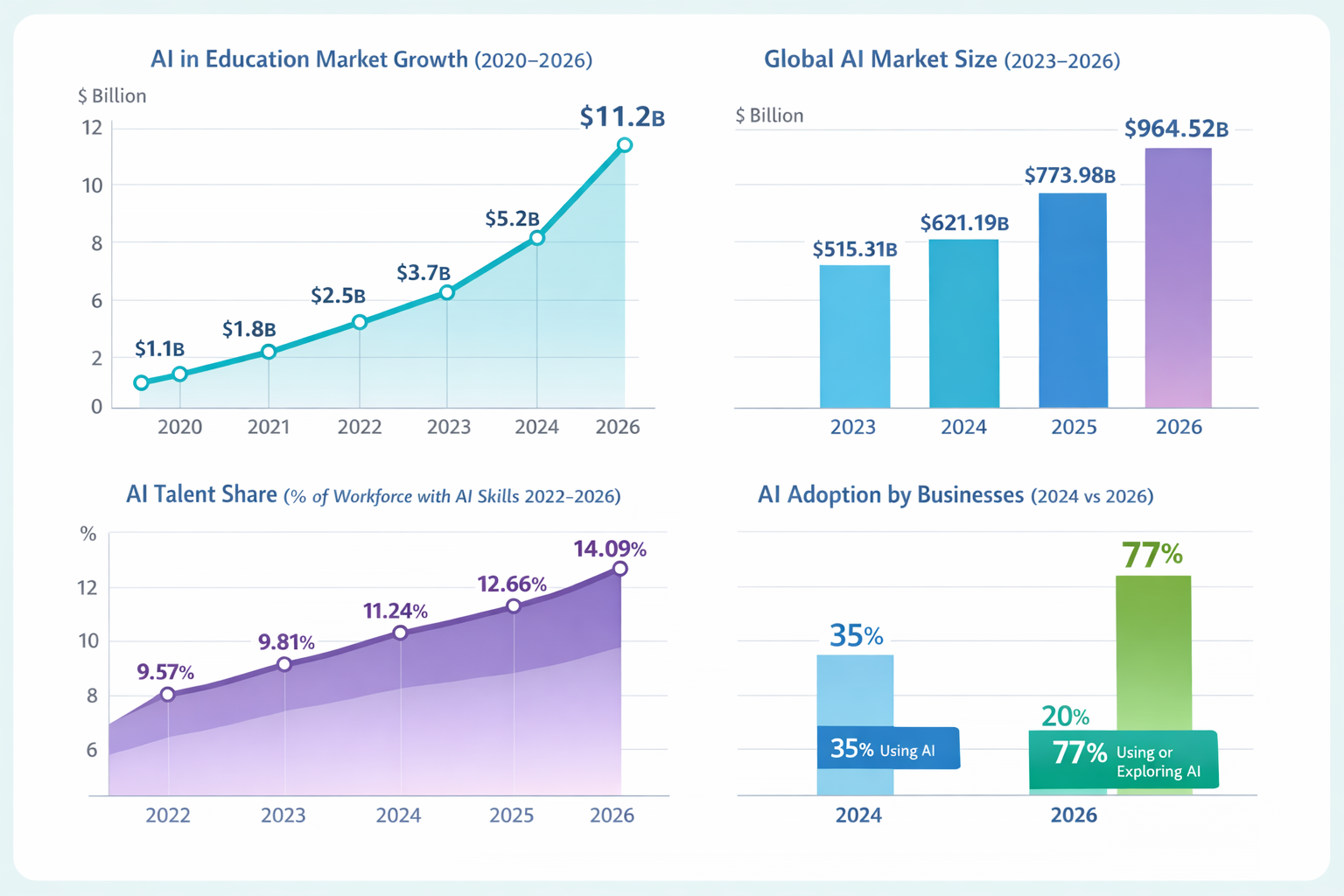
This infographic presents four data-driven charts highlighting real artificial intelligence growth trends from 2020 to 2026, based on trusted industry research and market reports.
The first chart is a line graph titled “AI in Education Market Growth (2020–2026)”, showing steady expansion of the AI in education market from $1.1 billion in 2020 to a projected $11.2 billion by 2026, reflecting rapid adoption of AI-powered learning technologies.
The second chart is a bar graph labeled “Global AI Market Size (2023–2026)”, illustrating the global artificial intelligence market’s growth from $515.31 billion in 2023 to an estimated $964.52 billion in 2026, highlighting the accelerating investment and commercialization of AI worldwide.
The third chart is a rising area chart titled “AI Talent Share (% of Workforce with AI Skills 2022–2026)”, showing an increase in AI-skilled professionals from 9.57% in 2022 to 14.09% in 2026, indicating strong demand for AI skills across industries.
The fourth chart is a comparison column chart named “AI Adoption by Businesses (2024 vs 2026)”, comparing 35% of businesses using AI in 2024 with 77% of companies using or exploring AI by 2026, demonstrating rapid enterprise-level AI adoption.
Prerequisites for Learning AI
You don’t need to be a math genius or programming expert to start this beginner guide to learn AI in 2026. But there are a few things that’ll make your journey smoother.
Basic Math Skills: You should be comfortable with high school level algebra. Understanding concepts like equations, graphs, and basic statistics will help. Don’t panic if math wasn’t your favorite subject, you can pick up what you need as you go.
Programming Fundamentals: Knowing the basics of at least one programming language helps a lot. Python is the most popular choice for AI, and it’s actually pretty beginner-friendly. If you’ve never coded before, spend a month learning Python basics before diving into AI.
Logical Thinking: AI is all about problem-solving. If you enjoy puzzles, figuring out how things work, or breaking down complex problems into smaller pieces, you already have this skill.
Computer Literacy: You should be comfortable using computers, installing software, and navigating the internet. That’s honestly about it for hard requirements.
Step-by-Step Complete Roadmap to Master AI
Let’s break down your learning journey into manageable phases. This beginner guide to learn AI in 2026 follows a practical path that thousands have successfully used.
Phase 1: Foundation Building (Months 1-2)
Start with Python programming if you haven’t already. You don’t need to become an expert, just comfortable with basics like variables, loops, functions, and working with data. There are tons of free resources online—pick one and stick with it.
Simultaneously, brush up on basic math. Focus on understanding what statistics and probability actually mean, not just memorizing formulas. Khan Academy has excellent free courses that explain things clearly.
Phase 2: Understanding AI Concepts (Months 3-4)
Now it’s time to understand what AI actually is. Learn the difference between AI, machine learning, and deep learning. Study how machines learn from data and make predictions. This phase is more about concepts than coding.
Take an introductory course that explains AI without getting too technical. Look for courses that use real-world examples and avoid heavy mathematical equations at this stage.
Phase 3: Hands-On Machine Learning (Months 5-7)
This is where things get exciting. Start working with actual machine learning algorithms. You’ll learn how to build models that can predict things, classify data, and find patterns. Libraries like scikit-learn make this surprisingly accessible.
Work on simple projects like predicting house prices, classifying emails as spam or not spam, or recognizing handwritten digits. These might sound basic, but they teach you fundamental skills you’ll use in every AI project.
Phase 4: Deep Learning and Neural Networks (Months 8-10)
Once you’re comfortable with basic machine learning, explore deep learning. This is the technology behind image recognition, language translation, and those impressive AI systems you hear about in the news.
Start with understanding how neural networks work conceptually, then build simple ones yourself using frameworks like TensorFlow or PyTorch. Don’t rush this phase—deep learning can feel overwhelming at first.
Phase 5: Specialization and Real Projects (Months 11-12)
By now, you should pick an area that interests you most. Natural language processing? Computer vision? Recommendation systems? Choose based on what excites you, then dive deep.
Build projects that solve real problems. Maybe create a chatbot for a local business, build an image classifier for a hobby you enjoy, or develop a tool that helps with something you find annoying. Real projects teach you more than any tutorial ever could.
How Long Does It Take to Learn AI?
Here’s the honest answer: It depends on what “learning AI” means to you. Following this beginner guide to learn AI in 2026, you can understand AI fundamentals in about 2-3 months of consistent study. To build your own machine learning projects, expect 6-9 months. To become genuinely proficient where companies would hire you for AI roles, you’re looking at 12-18 months of dedicated learning.
But here’s the thing—you don’t have to wait until you’ve “mastered” AI to get value from it. You can start using AI tools and building simple projects within weeks. Learning AI is more like learning a language than memorizing facts. You get better gradually, and there’s always more to discover.
The key is consistency. Spending 1-2 hours daily will get you much further than cramming 10 hours on weekends. Treat it like building a habit, not sprinting a race.
Common Challenges in Learning AI
Let’s talk about what’ll probably frustrate you, so you’re prepared. Every beginner faces these, and knowing they’re normal helps you push through.
Mathematical Overwhelm: AI courses often throw complex math equations at you. Remember, you’re learning to use AI, not necessarily to invent new algorithms. Focus on understanding concepts first, formulas second.
Information Overload: There’s so much AI content out there that it’s paralyzing. Stick to one resource at a time. Finish it before jumping to the next shiny course or tutorial.
Debugging Code: Your code won’t work perfectly the first time. Or the second. Or the tenth. That’s completely normal. Learning to debug is part of learning to code. Be patient with yourself.
Imposter Syndrome: You’ll feel like everyone else knows more than you. They don’t. They’re just at a different point in their journey. Stay focused on your own progress.
Keeping Up with Changes: AI evolves quickly. Don’t try to learn every new development. Master the fundamentals first—they don’t change much and they apply to everything else.
What Are the Best Resources to Learn AI?
The internet is packed with resources, but quality varies wildly. Here’s what actually works for beginners following this beginner guide to learn AI in 2026.
For Python Basics: Start with “Automate the Boring Stuff with Python” or Codecademy’s Python course. Both are beginner-friendly and practical.
For AI Fundamentals: Andrew Ng’s Machine Learning course on Coursera is legendary for a reason. It explains concepts clearly without dumbing them down. Fast.ai offers a more code-first approach that some people prefer.
For Hands-On Practice: Kaggle is your best friend. It has datasets, competitions, and notebooks where you can learn by doing. Plus, the community is incredibly helpful.
For Staying Updated: Follow AI newsletters like The Batch or Import AI. Listen to podcasts like “TWIML AI” while commuting. Join Reddit communities like r/MachineLearning and r/learnmachinelearning.
Books Worth Reading: “Hands-On Machine Learning” by Aurélien Géron is comprehensive and practical. “AI Superpowers” by Kai-Fu Lee helps you understand AI’s bigger picture and impact.
Don’t collect resources like Pokémon cards. Pick one or two that match your learning style and work through them completely.
Useful AI Tools for Everyone
You don’t have to build AI from scratch to benefit from it. Here are tools anyone can start using today, regardless of technical skill level.
ChatGPT and Claude: These conversational AI tools can help you learn, brainstorm, write, code, and solve problems. Think of them as incredibly knowledgeable assistants available anytime.
Notion AI and Grammarly: Perfect for writing assistance. They help you write clearer, catch mistakes, and organize thoughts better.
Runway and Midjourney: For creative types, these AI tools help generate and edit images and videos in ways that would’ve taken hours manually.
GitHub Copilot: If you’re learning to code, this AI pair programmer suggests code as you type, helping you learn faster and make fewer syntax errors.
Google Colab: A free tool that lets you write and run Python code in your browser, with powerful computers doing the heavy lifting. Perfect for running AI models without expensive hardware.
Jupyter Notebooks: Industry standard for data science and AI work. It lets you mix code, visualizations, and notes in one document.
The key is to actually use these tools. Don’t just read about them—open them up, play around, see what they can do. That hands-on experience is invaluable.
Making AI Learning Work for Your Life
Here’s what nobody tells you about following a beginner guide to learn AI in 2026: The hardest part isn’t understanding the concepts or writing the code. It’s staying consistent when life gets busy, when you’re tired, when Netflix looks more appealing than debugging Python errors.
Build AI learning into your routine. Maybe it’s 30 minutes every morning with coffee. Maybe it’s your lunch break. Whatever works for your schedule, make it regular. Small, consistent efforts compound into serious skills.
Find a community. Learning alone is tough. Join online forums, Discord servers, or local meetups where people are learning AI. Having others to ask questions, share progress, and commiserate with makes everything easier.
Build projects you actually care about. Don’t just follow tutorials—create something that solves a problem you have or explores a topic you love. Building an AI to predict your favorite sports team’s performance is way more motivating than generic tutorial projects.
Your AI Journey Starts Now
Look, AI might seem intimidating at first glance. The terminology is weird, the math looks scary, and everyone seems to be talking about it like it’s simultaneously going to save and end the world. But beneath all that noise is something genuinely fascinating and surprisingly accessible.
You don’t need to become an AI researcher or build the next ChatGPT. You just need to understand enough to use AI effectively, think critically about it, and maybe build a few cool projects along the way. This beginner guide to learn AI in 2026 gives you that roadmap.
The best time to start learning AI was a few years ago. The second best time is right now, today. Technology moves fast, and waiting for the “perfect moment” means you’ll always be playing catch-up. Start small, stay consistent, and be patient with yourself.
Six months from now, you’ll look back and be amazed at how far you’ve come. A year from now, you might be building AI solutions at work, freelancing on AI projects, or simply using AI tools with confidence and understanding. But none of that happens unless you take that first step today.
So what are you waiting for? Pick one resource from this guide, block out 30 minutes today, and start. Your future self will thank you for it.
Best YouTube Channels for AI Beginners
1. Simplilearn
Great for professional-style tutorials with beginner-friendly AI concepts and industry use cases.
Watch: “What is AI?”, “AI vs ML vs DL”
Link : Simplilearn YouTube
2. freeCodeCamp
Offers full-length, hands-on AI and machine learning courses with real coding.
Watch: “Machine Learning for Beginners – Full Course”
Link : freeCodeCamp YouTube
3. Codebasics
Explains AI and ML in simple language (English + Hindi), great for Indian students.
Watch: “Build Your Own Recommendation System”
Link : Codebasics YouTube
4. Tech With Tim
Perfect for coding real AI projects using Python, games, and neural networks.
Watch: “Build AI for Snake Game”
Link : Tech With Tim YouTube
FAQs: Common Questions Students Have About Learning AI
What will AI be able to do in 2025? AI in 2025 can create realistic images and videos, write code, engage in natural conversations, analyze medical images for diagnoses, drive vehicles in certain conditions, and automate complex business processes. It continues advancing rapidly across all fields.
Should you learn AI in 2025? Absolutely. AI skills are becoming as fundamental as computer literacy. Whether you want to advance your career, understand the technology shaping our world, or build your own AI-powered projects, learning AI offers tremendous value with relatively low barriers to entry.
Which AI is best for beginners? ChatGPT and Claude are best for beginners to understand AI through conversation. For learning to build AI, scikit-learn library with Python is most beginner-friendly. Google’s Teachable Machine offers a no-code way to create simple AI models.
Can I learn AI by myself? Yes, many successful AI practitioners are self-taught. With free online courses, documentation, YouTube tutorials, and communities like Kaggle and Reddit, you have everything needed to learn AI independently. Discipline and consistency are more important than formal education.
Books for AI Learners
- AI for Kids by Dale Lane – Visual and practical intro for students
- Artificial Intelligence: A Guide for Thinking Humans by Melanie Mitchell – Easy-to-understand concepts
- Python Machine Learning by Sebastian Raschka – Great once you’re comfortable with Python
- Hands-On Machine Learning with Scikit-Learn, Keras, and TensorFlow by Aurélien Géron – Project-based advanced book